I stayed deeply involved across this stream while mentoring a junior designer who drove detailed execution. My responsibility was to set direction, keep stakeholders aligned, and protect UX quality as the feature matured from MVP to GA and then V2.
DocGen Forms moved quickly from MVP ambitions toward GA expectations and V2 scope expansion. The risk was not just shipping late; the larger risk was shipping fragmented experiences where creation flow, navigation, and AI field behavior drifted apart across scenarios.
I saw that we needed stronger UX direction and cross-functional framing so implementation could move fast without losing clarity. This became especially important because a junior designer was owning detailed artifacts, and the quality bar depended on clear mentorship plus decision boundaries.
My approach was to create structured execution conditions: define the north-star interaction model, make tradeoffs explicit in review meetings, and keep PM-engineering-design loops synchronized so implementation choices did not dilute the UX model.
The final outcome was a more coherent DocGen Forms direction across creation flow, navigation, and AI field handling. Detailed UI execution was delivered by the junior designer, while I focused on preserving coherence and continuity in the system model as priorities shifted.
This let us keep product conversations grounded in reusable UX principles instead of one-off fixes, which improved readiness for GA and reduced rework pressure during V2 alignment.
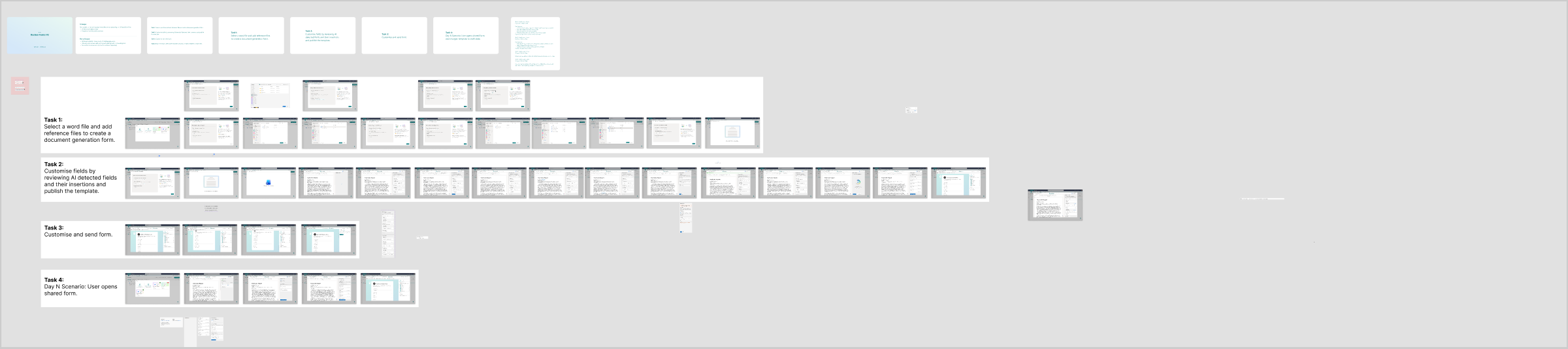
I used recurring evidence loops across meetings, design reviews, and chat/email threads to keep the stream stable. High-confidence signals included task assignment and iterative review cycles with Manasi, co-authored design POV work, GA blocker syncs I organized, and V2 alignment meetings with cross-team stakeholders.
This contribution model increased delivery resilience: execution stayed with the right owner while I kept strategic and cross-functional quality guardrails in place. That balance helped us move faster without compromising product coherence.
