I treated conditional visibility as a platform behavior problem, not a one-off feature. My job was to turn vague expectations around dynamic forms into a rule system that PM, engineering, and design could all reason about in the same way.
By late 2025, SPAI had strong momentum around forms-led workflows, but conditional behavior was still too fragmented to scale cleanly. Different scenarios needed fields, sections, and downstream steps to appear or disappear based on user input, yet the product did not have one consistent mental model for how that logic should work.
That created two problems at the same time: authors could not reliably predict what would happen in the form, and PM plus engineering teams did not have a stable UX language for discussing rule behavior, dependencies, or implementation tradeoffs.
My approach was to frame conditional visibility as a system of user-facing semantics instead of isolated controls. I centered the work on rule-builder UX, AND/OR evaluation behavior, show/hide outcomes, and the interaction language required to make the model understandable to both authors and builders.
The solution I finalized was not just a cleaned-up screen. It was a clearer interaction model for conditional visibility inside DocGen Forms: authors could define rule behavior with more confidence, the system could express show/hide logic more consistently, and downstream product conversations had a more stable semantic foundation.
In practical terms, the work established the UX direction for rule-builder behavior, clarified how visibility outcomes should be interpreted, and reduced ambiguity in the way dynamic form behavior was discussed across teams.
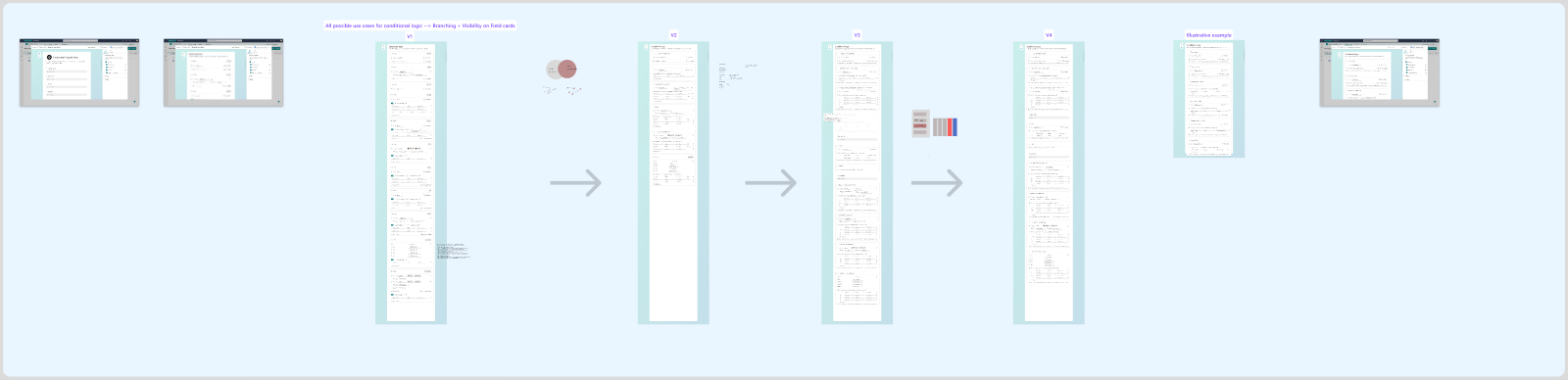
I solved this through repeated design exploration and alignment rather than a single proposal. From roughly Feb through May 2026, I used artifact reviews, wall reviews, and design conversations with PM and engineering to narrow the rule behavior into something that could survive implementation pressure.
The business value of this work was that it made dynamic forms more reusable across vertical scenarios. Instead of solving conditional behavior differently for each workflow, I helped define a logic system that could support broader platformization goals.