Hemant Gupta — Competitive Study Deep Dive
Strategic Research & Competitive Intelligence / Aug – Sep 2023

Contract Express
Teardown Study

A competitive analysis that surfaced a critical product constraint: Content Assembly was invoked from SharePoint Document Library and rendered the document inside a webpage iframe with a side panel, which made true in-canvas editing infeasible. These insights became the strategic push to deliver template creation and document generation directly in users' flow of work: Word documents.

Why Study Contract Express?

Contract Express held a commanding position in legal tech document generation—trusted by enterprises to create contracts through questionnaire-driven workflows. Microsoft was considering Content Assembly as an alternative entry point for legal workflows, but the positioning was unclear. The competitive question was direct: what does Contract Express do well, where does it fall short, and what does that teach us about the market's expectations?

🎯 Research Question
Can we understand Contract Express well enough to identify not just feature gaps, but architectural constraints in our current SharePoint-invoked model that required a different strategic direction?
Study Scope
  • Primary focus Template authoring + document generation workflows in Contract Express. How do power users and business users experience the platform?
  • Secondary focus Governance, approval, and collaboration patterns. Does Contract Express handle multi-user workflows well?
  • Comparative lens What would it take to exceed Contract Express while moving template creation and generation into users' native Word flow of work?
Strengths: Form-Driven Generation at Scale

Contract Express built an elegant mental model for legal document generation: templates author business rules and variables inside Word; end users answer a plain-language questionnaire; the system generates contracts without touching code. This pattern works because it outsources complexity to the questionnaire design phase.

  • Questionnaire-driven UX Users fill simple forms (not touching template logic). Reduces friction and lowers the skill floor for document creation.
  • Business rule engine Rules embedded in questionnaire logic determine which variables apply, auto-fill fields, and govern approval chains. Powerful for complex contracts.
  • Fast generation cycle Typical flow: start questionnaire → fill fields (5–15 minutes) → generate contract → done. No intermediate wizards or multi-step dialogs.
  • Word-native authoring Template authors work directly in Word (via add-in) to define variables, conditionals, and document structure. Familiar environment.
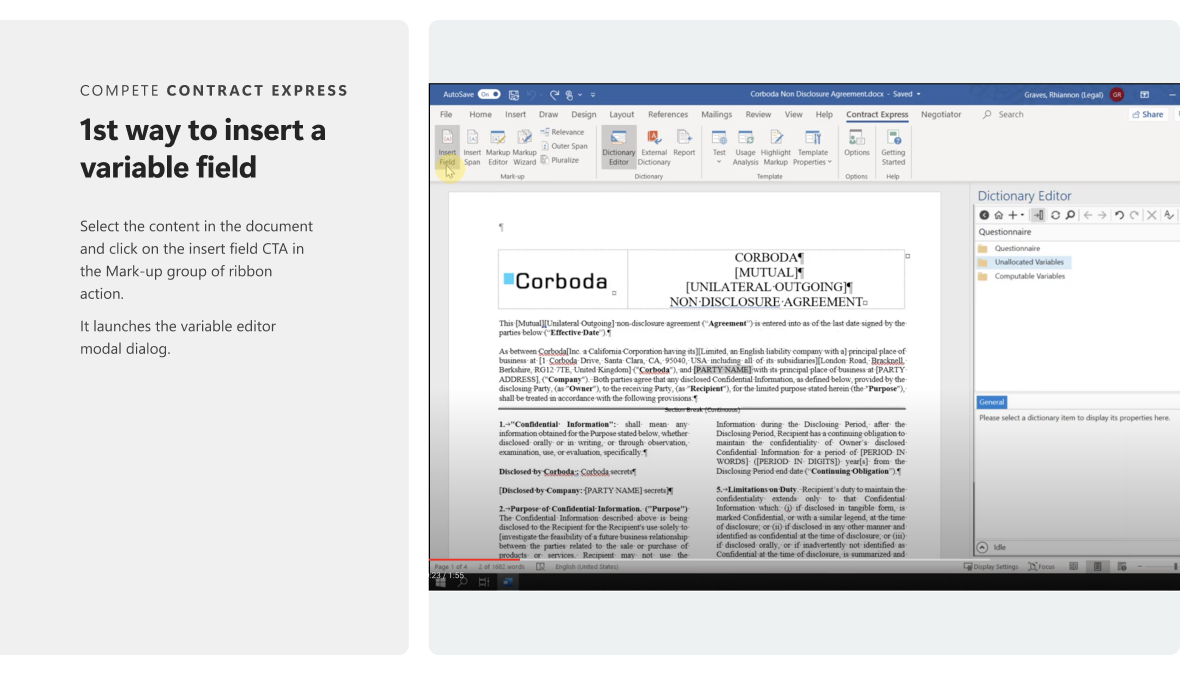
📐 Variable Authoring Inside Word Ribbon View Screen in Figma →
Contract Express Word ribbon flow showing insert variable field and dictionary editor
Why this mattered: This screen shows exactly where Contract Express is strong: variable authoring is embedded in the familiar Word canvas, reducing training load for legal ops teams.
Weaknesses: Governance + Collaboration Gaps

But Contract Express shows friction in areas where legal workflows become organizational challenges. The platform was built for template authoring + generation, not for the messy parts of enterprise contract work.

  • Approval workflows Limited multi-step approval chains. Fine for self-serve document generation; breaks down when contracts require review cycles.
  • Collaboration + versioning No built-in change tracking, comment threads, or revision history. Users resort to email and manual version numbering.
  • Knowledge management Snippet libraries and clause repositories are weak. Legal teams can't share or reuse contract clauses across templates easily.
  • Conditional complexity Business rule authoring (when questionnaire answers trigger which clauses) becomes a bottleneck. Power users struggle with conditional logic.
  • Template governance No centralized control for template updates. Changes ripple unpredictably across the organization.
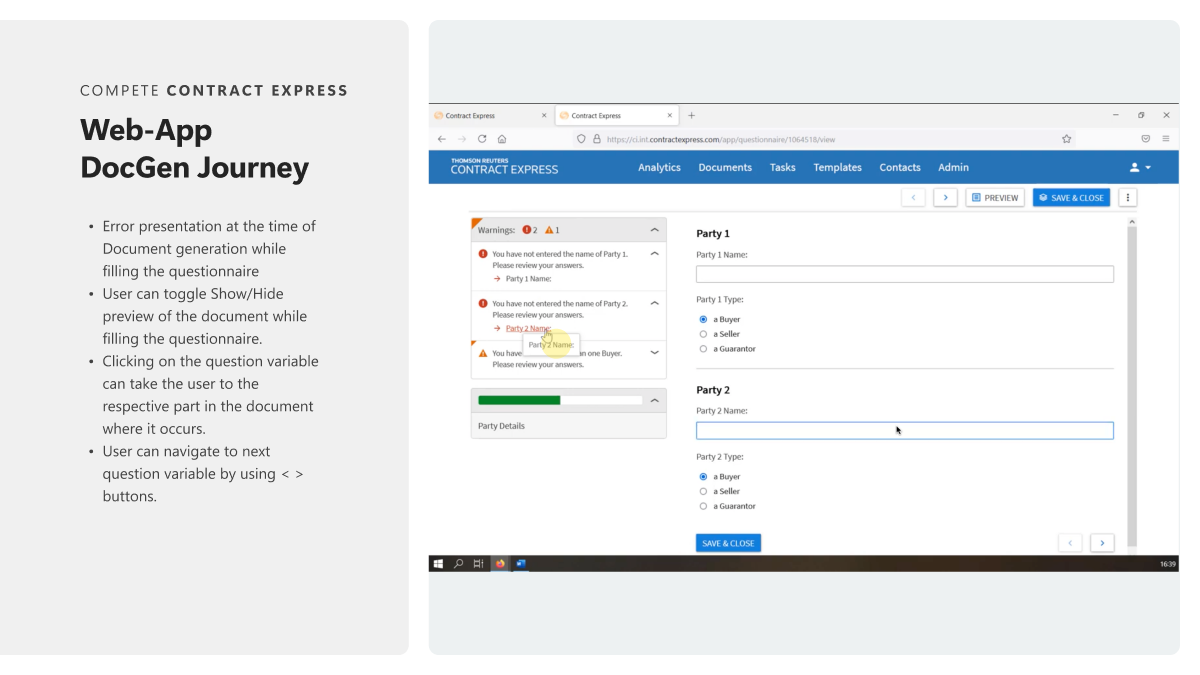
📐 Web-App DocGen Journey (Questionnaire + Preview + Warnings) View Screen in Figma →
Contract Express web app journey with questionnaire warnings and document preview controls
Observed friction: This panel-driven model mirrors the same limitation we had in Content Assembly: when the experience is orchestrated through a webpage shell and side panel, users are forced into context switching away from direct document interaction.
Insight #1: Architecture Was the Constraint, Not Just UX Preference

The key learning was not simply that users preferred in-document interaction. It was that our existing Content Assembly offering, invoked from SharePoint Document Library with the document rendered in a webpage iframe plus side panel, could not deliver true in-canvas editing by design.

⚡ Direct User Signal
"Task pane based experiences… not preferred. Experience immersive to the Word Canvas is required to match users' mental model." (CELA Interviews, Sep 2023)

This wasn't hypothetical. Legal professionals work in Word documents. They expect to create templates and generate documents within that environment. The iframe + side-panel pattern introduced unavoidable friction and became the evidence for relocating both capabilities into Word-native flow of work.

Insight #2: Forms ≠ The Entire Solution

Contract Express proves questionnaires work for initial data capture. But legal workflows are about more than questionnaires. They're about review, negotiation, collaboration, and change tracking. Forms handle the intake; the document is where the real work happens.

  • Forms excel at Initial data capture, guiding users through complex decision trees, reducing errors through validation.
  • Forms fail at Showing context (what does the clause actually say?), enabling inline edits (click to change text), tracking changes (who changed what?), collaboration (comments, review cycles).
Insight #3: Market Moving Toward Unified Workflows

Contract Express is single-function: generate documents via questionnaire. But enterprise legal teams don't work in single functions. They work across drafting → review → negotiation → execution. Fragmentation across tools is the pain point.

The strategic move was not "make the side panel better." It was "move template creation and document generation into Word-native flow of work," where creation, review, and execution can happen without architectural context switching.
From SharePoint-Invoked Assembly to Word-Native Workflows

The Contract Express study made the case for a fundamental strategic shift. Instead of continuing with a SharePoint-invoked iframe + side-panel assembly model, we needed to provide template creation and document generation directly inside Word, where legal professionals already do their core work.

The Strategic Logic
  • Contract Express validated Questionnaire-driven doc generation (forms layer) is valuable. Users appreciate the guided approach to data capture.
  • Constraint identified Content Assembly architecture (web iframe + side panel from SharePoint Document Library) could not support true in-canvas editing inside the document surface.
  • Microsoft's advantage We own Word. We can make a product that unifies forms (intake) + document (execution) + AI (review) + approval (governance) in one platform.
  • The pivot Move template creation and document generation into Word-native flow of work, replacing the SharePoint-invoked panel model with a document-first execution path.
🎯 Competitive Position
Contract Express showed clear market demand for guided generation in a document-centric workflow. Our opportunity was to remove the architectural gap in our own offering by making Word the native surface for template creation and generation, then layering review, approval, and AI on top.
What the Teardown Taught Design

This competitive study became the blueprint for how we'd design Agreements in Word. Every design principle traced back to a Contract Express strength or weakness:

  • Principle: Architecture-aware UX Do not promise in-canvas behavior on a surface that is iframe + side-panel by construction. Align interaction model with platform capabilities.
  • Principle: Questionnaires for intake Adopt Contract Express's approach to initial data capture, but embed it in the document experience (not a separate form).
  • Principle: Inline collaboration Contrast with Contract Express's weak approval workflows. Build change tracking, comments, and approval chains directly into the document.
  • Principle: AI + human expertise Where Contract Express relies on rules engines, we invest in AI—smart clause suggestions, risk detection, negotiation guidance.
  • Principle: Flow-of-work delivery Place template creation and generation where users already work every day: Word documents, not detached web orchestration surfaces.
Presenting the Pivot to Leadership

The Contract Express study became the foundation for the pitch to shift from Content Assembly to Agreements AI. The presentation highlighted an architecture reality: SharePoint-invoked iframe + side-panel orchestration limited direct document interaction, while Word-native delivery enabled template creation and generation in users' actual flow of work.

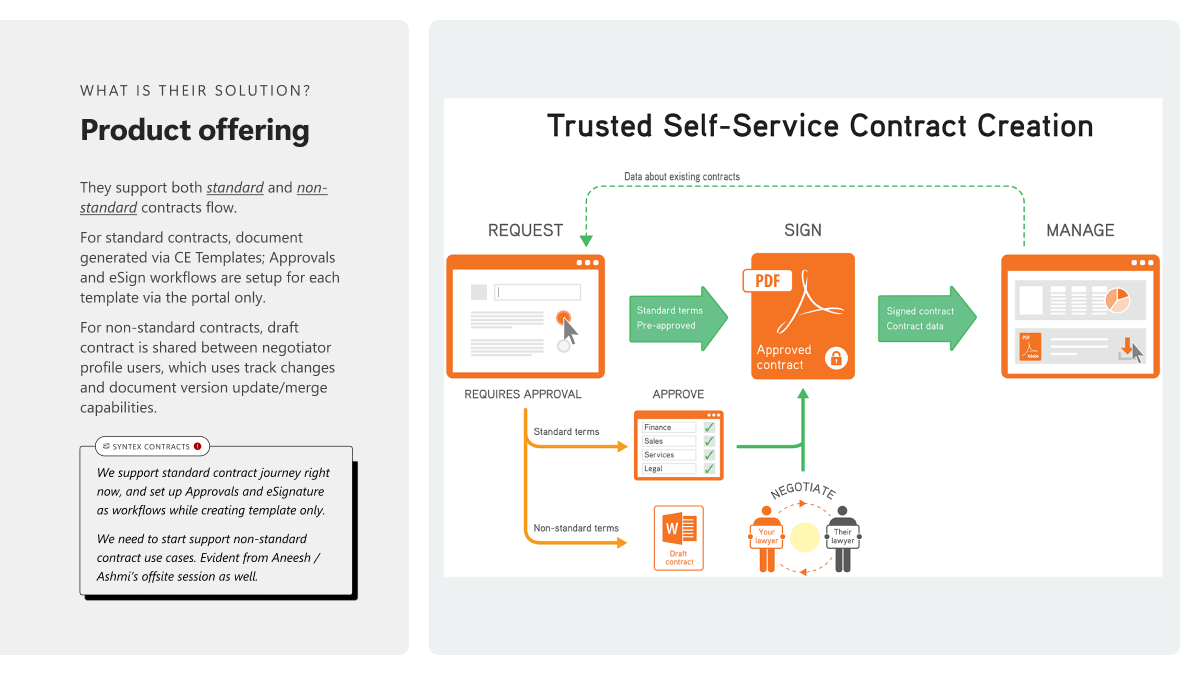
📐 Product Offering Model (Request → Sign → Manage) View Screen in Figma →
Contract Express product offering diagram showing request, sign, and manage lifecycle
How this was used in the LT narrative: This visual made the business model legible in one frame: intake (request), execution (sign), and operational continuity (manage). It helped frame where Microsoft could differentiate: stronger in-document collaboration and workflow governance on top of this lifecycle.
Key Arguments in the Pitch
  • Market validation Contract Express proves questionnaire-driven workflows work at enterprise scale. We're not inventing a new concept; we're executing it better.
  • UX + architecture insight User feedback and platform constraints aligned: panel-first orchestration was not enough, and Word-native flow was required for the target legal experience.
  • Platform advantage We own Word. Contract Express runs on top of Office. We can build integration that is 100x deeper.
  • Scope clarity Instead of trying to be everything in Content Assembly, focus on one use case (legal contracts) and own the entire workflow.
  • Time window Legal tech is moving to the cloud. Contract Express is legacy. If we move now (Sep 2023), we can establish Word + Agreements as the new standard.
The Pivot That Changed Everything

The Contract Express teardown study was catalyst for the strategic decision to pivot from Content Assembly (SharePoint-invoked iframe model) to Agreements AI (Word-native model). This wasn't a minor UX tweak; it was a platform-level reorientation toward delivering template creation and generation in the user's document flow of work.

  • Sep 2023: Strategy locked Leadership approved the pivot to Word-native Agreements based on this research. Committed resources shifted from Content Assembly to Agreements development.
  • Q4 2023 – Q2 2024: Execution Agreements AI shipped with Word canvas integration, questionnaire-driven template selection, and inline collaboration. The design principles defined by Contract Express analysis shaped every detail.
  • 2024 – 2026: Growth Agreements became the fastest-growing feature in the legal tech portfolio. Legal teams preferred the Word-native experience over legacy solutions. Market validation confirmed the pivot was correct.
A single competitive study can justify a three-year strategic shift. The Contract Express teardown wasn't just research; it was the strategic foundation for everything that followed in legal tech at Microsoft.
Design Leadership Contribution

This work exemplified design as strategy, not decoration. The study identified not just feature gaps, but a structural platform mismatch between intended experience and delivery surface, then translated that into a clear product direction: Word-native template creation and generation. That's the kind of competitive intelligence that changes organizational direction.